pH 12
Extremely Alkaline Waters Create One of Earth's Most Unique Ecosystems.
Lake Natron is one of the most extraordinary — and most misunderstood — destinations in Tanzania. Its water can reach pH 12 and 60°C. It turns blood-red. It kills most animals that enter it. And yet 2.5 million lesser flamingos choose it as the only regular breeding site in East Africa. This guide covers everything: the science, the flamingos, the volcano climb, the hidden waterfall, the ancient footprints, and exactly how to visit from Arusha.
Extremely Alkaline Waters Create One of Earth's Most Unique Ecosystems.
Surface Water Temperatures Can Reach Extraordinary Heat During Dry Seasons.
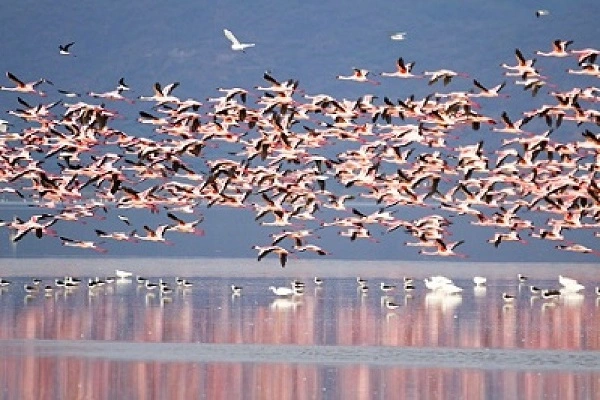
Lesser Flamingos Gather Here in One of Africa's Greatest Wildlife Spectacles.
Approximately Three-Quarters of the World's Lesser Flamingos Hatch Here.
 Lake Natron — the lake at its most vivid dry-season red
 Lesser flamingos — 2.5 million breed here
Lake Natron is not a conventional lake. It has no outflow — water flows in from the Southern Ewaso Ng'iro River and from mineral-rich hydrothermal hot springs fed by the nearby Ol Doinyo Lengai volcano, but water can only leave by evaporation. In the extreme heat of the Gregory Rift — where daytime temperatures regularly exceed 40°C — the lake loses water at a rate that concentrates whatever minerals remain behind. Over thousands of years, this process has deposited massive quantities of natron (hydrated sodium carbonate) and trona (sodium sesquicarbonate dihydrate) — the two salts from which the lake takes its name.
The result is a lake so alkaline that it approaches ammonia in its corrosive properties. The pH of Lake Natron ranges from 9 to 12 depending on water level — with the extreme end reached during the dry season when evaporation is at its peak. Water temperatures at the surface can reach 60°C near the hydrothermal hot spring inflows. Most fish, invertebrates, and land animals that enter the water are rapidly killed by the caustic conditions — their bodies sometimes mummified in the lake's mineral deposits.
"The lake is beautiful and lethal in equal measure. The water that petrifies birds is the same water that gives birth to 75% of the world's lesser flamingos. It is one of nature's most extraordinary contradictions."
— Resilience Safaris guide, Lake Natron, 2025The red colour that makes Lake Natron unmistakable from space is not from the minerals themselves — it comes from life. Salt-tolerant microorganisms called halophiles, specifically cyanobacteria (Arthrospira fusiformis) and halobacteria, thrive in the extreme alkaline conditions. These organisms produce carotenoid pigments — red and orange compounds — as a byproduct of photosynthesis in high-UV environments. In shallow, highly concentrated zones, the lake turns deep crimson. Slightly deeper water appears orange or pink. The transition zones between concentrations create the extraordinary gradient of colour visible in aerial photography.
The intensity of the colour shifts with the season. In the dry season (June–October), as water levels drop and salt concentration peaks, the crimson is most vivid. During the rains (November–May), dilution reduces the concentration and the colour lightens. The most spectacular red is typically seen between August and October — coinciding with the flamingo breeding season.

Do not touch or enter the lake water. Direct contact with Lake Natron's alkaline brine causes severe chemical burns to skin and eyes. The dried salt crust on the lakeshore is safe to walk on with a guide, but the liquid beneath the crust is hazardous. All lakeshore walks must be conducted with a TANAPA-registered guide who knows the safe zones. Never approach the lake alone.
Lake Natron is the only regular breeding site for East Africa's lesser flamingo population — a title it holds because of, not despite, its extreme conditions. The IUCN classifies the lesser flamingo (Phoeniconaias minor) as Near Threatened specifically because of this dependence: 75% of the world's 6 million lesser flamingos are born at Lake Natron, and any sustained disruption to the lake would devastate the global population.
The flamingos' relationship with the lake is one of evolution's most elegant adaptations. Their scaly, tough legs are resistant to the caustic water that kills most animals. Their downward-curved bills filter the blue-green algae and cyanobacteria that grow in the alkaline shallows — the same organisms that produce the lake's red colour. They nest on small islands of dried salt that form naturally in the shallows during the breeding season, which keeps predators — who cannot cross the caustic mud flats — at a safe distance.
Flamingos are present at Lake Natron year-round, but the breeding season peaks August–October. Eggs are laid August–October and hatch in November–December. Peak flamingo numbers coincide with the dry season's deepest red lake colour. Confirm flamingo status with your guide before arrival — breeding activity varies year to year based on water levels.
The two flamingo species at Lake Natron — lesser and greater — are physically and behaviourally distinct. The lesser flamingo is smaller, more vibrantly pink, and feeds exclusively on cyanobacteria in the alkaline shallows. The greater flamingo (Phoenicopterus roseus) is larger and paler, and feeds on invertebrates in slightly less alkaline water. Both species use Lake Natron, but the lesser flamingo's dependence is existential: remove this lake and the species faces catastrophic population collapse. This is why conservation proposals to dam the Ewaso Ng'iro River (Lake Natron's primary inflow) have faced international opposition from ornithologists and conservation organizations worldwide.
Lake Natron is not a conventional safari destination — there is no game drive circuit inside the conservation area. What it offers instead are five activities that are genuinely impossible anywhere else on the Tanzania northern circuit.

Ol Doinyo Lengai — "Mountain of God" in Maasai — is an active volcano approximately 20 km south of Lake Natron. It is the only active carbonatite volcano in the world, erupting with black natrocarbonatite lava rather than conventional red silica lava. The climb departs at midnight or 01:00 to avoid the crushing daytime heat and to reach the summit at sunrise — when views extend over Lake Natron, the Ngorongoro Crater, and on clear mornings, both Kilimanjaro and Mount Kenya. The upper section is extremely steep, rocky, and covered in slippery ash. Prior hiking experience is strongly recommended. A Maasai guide leads the climb and descent.

Guided walks along the Lake Natron shoreline are the most accessible activity at the lake. The guide navigates the safe walking zones on the salt crust, positioning guests for optimal flamingo viewing without disturbing the colony. Early morning light turns the lake's surface gold and pink simultaneously — flamingo photography conditions are best between 06:30 and 09:00. On clear mornings, Ol Doinyo Lengai's ash-whitened silhouette provides the backdrop. Flamingos are present year-round, with the largest concentrations from August to November.

The Ngare Sero Gorge walk is the most scenically dramatic activity at Lake Natron — and completely unexpected in this arid landscape. The trail follows the Ngare Sero River upstream through a narrow basalt gorge, wading through clear freshwater pools, past tropical palms growing from volcanic rock, and alongside dramatic rock formations. The gorge opens at Ngare Sero Waterfall — a curtain of fresh water dropping into a natural pool surrounded by ferns and lush vegetation that seem impossible in the surrounding desert. The contrast with the desolate, heat-cracked lakeshore is disorienting. This hike is suitable for most fitness levels and is one of Lake Natron's best-kept secrets.

On the southern shore of Lake Natron, approximately 14.5 km from Ol Doinyo Lengai, a set of human footprints is preserved in compressed volcanic ash. Scientists have documented over 400 individual footprints attributed to at least 20 different people, dating to between 5,000 and 19,000 years ago. No other African site contains as many ancient Homo sapiens footprints — making this one of the most important archaeological sites on the continent. The footprints are believed to be those of a group — possibly hunters or travellers — who crossed a wet ash deposit and whose tracks hardened before being buried and then re-exposed by erosion. The guided walk to the footprint site takes approximately 30 minutes from the main camp area and is best combined with a lakeshore flamingo walk at sunset.

The Engaresero Maasai community manages much of the Lake Natron conservation area and has developed a cultural tourism programme. Visits include a walking tour of the village, demonstrations of traditional Maasai jumping dances, explanations of the lake's role in Maasai culture and spirituality, and visits to traditional boma homesteads. The Maasai have lived alongside Lake Natron for centuries and their knowledge of the lake's cycles, the volcano, and the flamingo behaviour is unmatched. Local community guides speak English and offer context impossible to access through external tour operators alone. Community fees go directly to the Engaresero village.
Lake Natron is open year-round, but the experience changes dramatically with the season. The lake's colour, flamingo numbers, road conditions, and temperature all shift significantly between wet and dry season. Here is exactly when to visit for each type of experience.
Lake Natron is approximately 167 km from Arusha by road — but the road quality makes this a 5 to 6-hour journey. A 4x4 vehicle is not optional — it is essential. The final section of both routes is unpaved, rutted, and crosses dry riverbeds that can be impassable when wet. There is no public transport to Lake Natron. The only reliable options are a guided 4x4 safari vehicle or a chartered light aircraft.
| Route | Via | Distance | Time (4x4) | Road condition |
|---|---|---|---|---|
| Southern Route | Arusha → Mto wa Mbu → Engaruka → Natron | ~167 km | 5–6 hrs | Recommended |
| Northern Route | Arusha → Longido → Gelai → Natron | ~160 km | ~5 hrs | Alternative |
| From Serengeti | Klein's Gate → Wasso → Natron | ~200 km | 5–7 hrs | Rough — scenic |
| Light aircraft | Arusha Airport → Ngare Sero airstrip | ~30 min flight | 30 min | Easiest option |
The southern route via Mto wa Mbu is recommended for first-time visitors. It passes through the spectacular Rift Valley escarpment, the village of Engaruka (with archaeological ruins), and the open Maasai plains before arriving at the lake. The northern route via Longido is shorter in distance but passes through more remote territory — better for experienced off-road travellers or those combining Lake Natron with a Longido community walk. If arriving from the Serengeti, do not attempt the Klein's Gate to Lake Natron drive in a single day from central Serengeti — overnight at Klein's Gate first.
Accommodation options at Lake Natron are limited and intentionally simple — this is one of Tanzania's most remote destinations, and the camps reflect that. Expect tented camps and basic lodges rather than luxury. The trade-off is extraordinary — waking up on the lake's shore at dawn, with flamingos visible from your tent and Lengai on the horizon, is an experience no luxury lodge in the Serengeti can replicate.
All accommodation is concentrated in and around Engaresero village, approximately 1–2 km from the lake's southern shore. There is no cell phone reception at most camps, limited or no Wi-Fi, and electricity typically from solar panels or generators. Bring cash — there are no ATMs within 4–5 hours.

A severe storm in early 2026-2027 caused significant damage to Ngare Sero Lake Natron Camp. Confirm current status directly with any camp before booking. Africa Safari Lake Natron (the most established mid-range option) was unaffected and continues to operate. Resilience Safaris maintains current accommodation status for all Lake Natron visits — contact us before booking any camp independently.
Lake Natron is genuinely remote. Preparation matters here more than at any other destination on the Tanzania northern circuit. Here is the non-negotiable checklist for a safe and memorable visit.
Footwear: Closed-toe shoes or boots for the lakeshore walk (the salt crust can be sharp) and a second pair for the Ngare Sero gorge hike (you will get wet). Clothing: Light, long-sleeved clothing for sun protection — the heat is severe and shorts offer no UV protection for long walks. Binoculars for flamingo viewing (the main colony is often 100–300 m from the shore). Camera with telephoto lens — flamingo photography requires at minimum a 200mm lens for close detail. Headlamp with spare batteries for the overnight Lengai climb. Warm layer for the Lengai summit — the summit is cold even in the dry season.