The complete science and spectacle of the Great Migration
What is the Great Wildebeest Migration? — The Complete 2026 Guide
The Great Wildebeest Migration is the largest terrestrial animal movement on Earth — 1.5 million wildebeest, 300,000 Burchell's zebra, and 500,000 Thomson's and Grant's gazelle completing a 1,200-kilometre circular route through the Serengeti-Mara ecosystem every year. The migration has been running continuously for hundreds of thousands of years. It is driven entirely by rainfall, grass growth, and the instinctive imperative of the wildebeest to follow the green — the emerging short-grass growth that follows Tanzania's two annual rainy seasons. There is no leader, no navigation, and no destination. The migration is a biological phenomenon as ancient as the Serengeti itself.
The circular route runs clockwise: south to the short-grass Ndutu plains in December; calving January–February; northward through the long-grass central and western Serengeti in March–June; the Grumeti River crossing in June; the northern Serengeti and the Mara River crossings July–October; then south again as the short rains bring the new grass to the southern plains in November–December. The cycle repeats without pause. At any point in the year, the migration is somewhere in the ecosystem — always accessible, always different, always extraordinary.
The migration involves species beyond wildebeest. Burchell's zebra lead the migration column — they can digest tougher, longer grasses that wildebeest cannot, effectively opening the grassland for the wildebeest herds that follow. Thomson's gazelle follow the wildebeest, eating the short stubble the wildebeest leave behind. The three-species progression — zebra, wildebeest, gazelle — has evolved over millennia to maximise grassland efficiency across the entire ecosystem. This ecological relationship is part of what makes the migration so biologically remarkable: it is not one species' behaviour but an entire grassland ecosystem in continuous, coordinated motion.

The wildebeest do not migrate toward a fixed destination — they migrate toward green grass. Tanzania's Serengeti-Mara ecosystem receives rainfall in a bimodal pattern: the long rains (March–May) and the short rains (October–December). Green, nutritious short grass grows in the wake of rainfall and is the wildebeest's primary food source. The circular migration route precisely tracks the sequence of grass growth across the ecosystem — the wildebeest move to where the grass is at its optimal nutritional stage. The navigational intelligence involved is chemical and olfactory: the wildebeest detect rainfall and fresh grass growth from up to 50 kilometres away. The entire migration route is effectively a real-time map of the ecosystem's nutritional state.
Track the herds — month by month
The Great Migration — Complete Monthly Timeline 2026–2027
The most detailed month-by-month migration tracking guide available for 2026 and 2027. Use this to plan the exact timing of your migration safari for the specific event you want to witness — whether calving season, Grumeti crossings, Mara crossings, or the green season long-grass movement.
January
2026 / 2027
Southern Serengeti · Ndutu · Short-grass Plains
Pre-Calving Concentration — Herds Assembling in South
The full migration herd — all 1.5 million wildebeest — is concentrated on the short-grass plains of Ndutu and the southern Serengeti. Pre-calving behaviour intensifies: females visibly pregnant, herds extremely dense. The first calves begin appearing in late January. Cheetah families, lion prides, and wild dog packs pre-position around the assembling herds. Extraordinary predator density in the short-grass plains.
High season · Peak wildlife startingFebruary
2026 / 2027
Ndutu · Southern Short-Grass Plains
PEAK CALVING SEASON — 8,000 Calves Born Per Day
The most extraordinary wildlife event of the migration year. At peak calving, approximately 8,000 wildebeest calves are born every 24 hours. The short-grass plains are populated with newborns stumbling to their feet within minutes of birth. Every predator in the ecosystem converges: cheetah, lion, wild dog, spotted hyena, martial eagle, and jackals. Predator-prey encounters are continuous, close, and visible across open terrain. The finest wildlife photography month of the entire Serengeti year.
Peak wildlife event · Best photography · High seasonMarch
2026 / 2027
Central Serengeti · Long-Grass Plains
Post-Calving Northward Movement Begins
Long rains arrive, triggering the northward movement. Herds begin moving through the central Serengeti long-grass plains. Zebra lead the column. Calves now mobile and running with the herd. The landscape transitions from the short-grass openness of Ndutu to the long-grass central plains. Resident predators excellent; migration wildlife in transition zone between southern and central zones.
Value season starts · 25% lower ratesApril
2026 / 2027
Central Serengeti · Moving to Western Corridor
Long-Grass Central Plains — Northward March Continues
Long rains at their most dramatic — thunderstorms, vivid green savanna, dramatic skies. Herds spread across the central Serengeti long-grass plains in large numbers. Resident predators — kopje leopards, Seronera lion prides, central cheetah families — excellent. Tourism at its lowest; accommodation rates at 30–40% below peak. The secret migration season for budget-conscious wildlife travellers.
Best value season · Dramatic landscapes · Low crowdsMay
2026 / 2027
Western Corridor · Approaching Grumeti
Western Corridor Build-Up — Grumeti River Approaching
Herds streaming through the Western Corridor toward the Grumeti River. Long rains continuing, roads occasionally challenging. The Grumeti River pools hosting the giant crocodile populations that have been waiting. First small Grumeti crossings possible late May. Western Corridor is significantly less visited than the northern zone — intimate wildlife encounters. Singita Grumeti concession is optimally positioned for this period.
Value season · Grumeti build-upJune
2026 / 2027
Western Corridor · Grumeti River · Moving North
GRUMETI RIVER CROSSINGS — World's Largest Crocodile Encounter
The Grumeti River crossing season — the migration's first major crossing event. The Grumeti's Nile crocodile population includes the largest individuals in the world (5+ metres). Crossings are more intimate than the Mara because the river is narrower and viewing positions are closer. Significantly fewer tourists than the Mara in July–September. Herds also beginning to move into the northern Serengeti by late June. High season starts as dry season arrives.
High season · Grumeti crossings · Largest crocodilesJuly
2026 / 2027
Northern Serengeti · Mara River · Lamai Wedge
MARA RIVER CROSSING SEASON BEGINS — World's Greatest Wildlife Event
The Mara River crossing season opens in July as the first major herds reach the northern Serengeti. The Lamai Wedge and northern crossing points begin receiving build-up. Early July crossings are less densely populated but often more intimate. The resident predator community — lion, cheetah, wild dog — at full crossing-season intensity. Peak season accommodation rates now at maximum. Book 6–12 months ahead for July 2026.
Peak season starts · Book 6–12 months aheadAugust
2026 / 2027
Northern Serengeti · Multiple Mara Crossing Points
PEAK MARA RIVER CROSSINGS — Maximum Herd Density at Crossing Points
The peak Mara crossing month — the highest herd density at the northern crossing points, the most frequent crossing attempts, and the most dramatic predator-crocodile-wildebeest interactions. Multiple crossing attempts per day at different crossing points. The guide's intelligence network is at its most active — daily crossing point assessment from overnight reports. The most sought-after single month of the Tanzania safari year. 7-day package (4 Serengeti days) is essential for meaningful crossing probability.
PEAK MONTH · Maximum crossings · 7-day recommendedSeptember
2026 / 2027
Northern Serengeti · Sustained Mara River
SUSTAINED MARA CROSSINGS — Best Overall Crossing Probability
September consistently delivers the highest crossing probability of any month — the herds are committed to the northern zone, the guide intelligence network has three months of accumulated crossing point mapping, and the slightly lower visitor volume compared to August (though still peak) makes positioning more effective. September is the expert safari community's preferred crossing season month. Accommodation rates remain at peak. 7-day and 10-day packages most popular in September.
Experts' preferred crossing month · Highest probabilityOctober
2026 / 2027
Northern Serengeti · Beginning Southward Return
Final Mara Crossings — Herds Beginning Southward Return
The final Mara crossing month — still excellent but herds beginning to shift back south as short rains arrive in late October. Early October crossings are still peak-quality. Late October sees herds dispersing southward. The crossing season overlaps with the beginning of the short rains — dramatic thunderstorm skies make October extraordinary for photography. Lower visitor volumes than August–September with comparable wildlife.
Final crossings · Dispersing south · Dramatic skiesNovember
2026 / 2027
Central and Southern Serengeti · Moving South
Short Rains — Herds Flowing South Toward Ndutu
Short rains bring the landscape from dry brown to vivid green in days. Herds flowing south through the central Serengeti — large columns visible across the plains. Excellent photography conditions with dramatic clouds. Accommodation rates drop 15–25% from peak. Resident predators at their usual excellent standard. Good Serengeti wildlife at value pricing. An underrated safari month.
Good value · Lush green landscapes · Herds flowing southDecember
2026 / 2027
Southern Serengeti · Approaching Ndutu
Pre-Calving South — Herds Massing in Preparation
The herds complete their southward return, massing on the short-grass plains of the southern Serengeti in preparation for the calving season. The cycle begins again. December delivers large herd concentrations on the southern plains, good wildlife at shoulder-season rates, and the beginning of the pre-calving intensity that builds toward January's extraordinary spectacle.
Good season · Pre-calving build-up · Reasonable ratesComplete migration safari collection — 3 to 10 days
Serengeti Migration Safari Packages 2026 — Every Duration and Budget
Every migration safari package that delivers Serengeti migration wildlife access. All private packages include a dedicated 4x4 vehicle, licensed expert guide, all Serengeti park fees, accommodation, and meals. The number of consecutive Serengeti days is the most critical factor for migration quality — each additional day adds accumulated intelligence that produces significantly better encounters.

3-Day Migration Safari
Entry-level migration circuit. Tarangire and Ngorongoro Crater plus one full Serengeti migration day. Expert guide applies overnight network intelligence for Day 1 migration positioning.
4-Day Migration Safari
Two consecutive Serengeti days — the intelligence breakthrough point. Day 2 applies Day 1's complete ecosystem map for direct precision positioning. First meaningful calving or crossing session.
5-Day Migration Safari
The most popular migration safari. Three consecutive Serengeti days — Day 3 deep access enabled by two prior days of intelligence. Meaningful crossing and calving season probability across all migration phases.
6-Day Migration Safari
Four Serengeti days — the intelligence reaches maximum circuit precision. Four consecutive days in the calving zone or at crossing points produces encounters impossible in shorter formats.
7-Day Migration Safari
The gold standard crossing season safari. Five consecutive Serengeti days — maximum Mara River crossing probability. Four prior days of intelligence on Day 5 positions the vehicle at the exact correct crossing point at the optimal time.
8-Day Migration Safari
Six consecutive Serengeti days — the pinnacle of the migration format. Maximum crossing window with multiple crossing events possible. Calving season full calving cycle observable across six days.
9-Day Migration Safari
Seven consecutive Serengeti days — apex migration access. Complete ecosystem knowledge by Day 4. Individual predator family cycles mapped, crossing points mastered, calving zones fully understood.
10-Day Migration Safari
The ultimate migration safari — eight consecutive Serengeti days. The migration as a world you inhabit for more than a week. Every daily phase understood, every crossing point mastered, every calving zone mapped.

The 4-day group joining safari ($760 per person) includes one Serengeti migration day and is the most affordable way to experience the Great Migration. The 5-day group joining flagship ($920 per person) delivers two consecutive Serengeti days with Day 2 intelligence applied. The 6-day group joining maximum ($1,070 per person) delivers three consecutive Serengeti days — the maximum available in the group joining format. All group joining options use the same expert licensed guides, the same park access, and the same migration tracking intelligence as the private safari options. Contact us for current group joining availability.
The world's most dramatic wildlife event — phase by phase
The Mara River Crossing — The Complete Expert Guide
The Mara River crossing is the migration's defining event — the moment most often photographed, most often described in superlatives, and most often misunderstood. Understanding how a crossing actually happens — the build-up, the trigger, the chaos, and the aftermath — is the most important knowledge a Serengeti safari guest can carry into the crossing season. It is also the knowledge that transforms a disappointing one-day crossing attempt into a successful multi-day crossing experience.
The Physiology of a Crossing — How It Actually Happens
A Mara River crossing does not happen because the wildebeest decide to cross. It happens because of a specific neurological trigger that builds across several days of approaching the river and then releases in an instant. The wildebeest are terrified of the crossing — the river contains thousands of Nile crocodiles, fast water, and steep banks. They approach the crossing point, look at the water, and retreat. They approach again. They retreat again. This process repeats across hours or days. The guide observes the approach pattern and assesses the commitment level — how close the lead animals are coming to the water, whether they are pawing the ground, whether the herd behind them is dense enough to create the "push" that triggers the crossing.
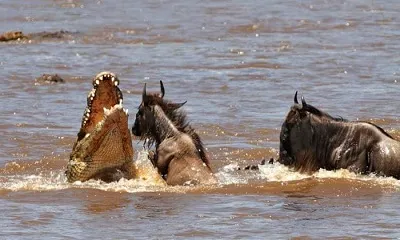
The crossing trigger is usually a combination of two events: the lead animals reach a point of no retreat — pushed by the mass of the herd behind them — and one animal takes the first step into the water. Once the first animal enters, the neurological herd response is immediate — thousands of wildebeest follow within seconds, producing the chaotic, multi-thousand-animal cascade that constitutes a full crossing. A committed crossing lasts anywhere from 8 minutes to 45 minutes. After the crossing is complete, the herd continues northward (or southward on the return), and the crocodiles return to their holding positions until the next approach begins.
Approach and Build-Up — Days of Anticipation
The guide's overnight network reports crossing point build-up — increasing herd density at the riverbank, evidence of multiple approach attempts. The vehicle positions at the crossing point by dawn. The herd approaches the river, the lead animals reach the bank edge, look down at the water, and retreat. This cycle repeats multiple times over the day. The experienced guide assesses commitment level from the animals' behaviour — body language, approach distance, herd density. "Build-up Day 2" means the crossing is likely in the next 24–48 hours.
The Commitment Moment — The Point of No Return
The guide has identified the commitment threshold — the moment when the lead animals reach the water's edge and the herd behind them is too dense and too committed to allow retreat. The vehicle is stationary at the pre-positioned camera angle — upstream for the crossing cascade, downstream for the crocodile interaction, or lateral for the full crossing spectacle. The guide silences the vehicle. All cameras are ready. The lead animal enters the water.
The Crossing — Thousands in the Water Simultaneously
The crossing. Thousands of wildebeest in the water simultaneously — churning, leaping, swimming, some swept downstream, some climbing the far bank, calves separated from mothers, crocodiles moving through the mass. The noise — hooves on rock, splashing, bellowing — is audible from a kilometre away. The dust and mist from the crossing create a visual spectacle unlike anything in the natural world. The crossing ends when the last animal either crosses or retreats. The crocodiles return to waiting positions. Silence returns to the river.
The Aftermath — Intelligence Banking for the Next Cross
The guide documents the crossing: the crossing point used, the approach pattern, the commitment trigger, the duration, and the estimated herd numbers. This information is shared across the guide network before dawn the next day. A new build-up may already be forming at a different crossing point — the guide assesses which crossing point is most likely to produce the next committed crossing and positions accordingly. The intelligence accumulation continues regardless of whether a crossing occurred — each day's observation makes the next day's prediction more precise.
Tanzania's most underrated wildlife event — the complete science
Calving Season Deep Dive — January and February 2026–2027
The wildebeest calving season in Tanzania's Ndutu and southern Serengeti is one of the most extraordinary wildlife events in the world — and in many respects delivers more consistently rewarding daily wildlife encounters than the famous Mara River crossing season. This section is the most detailed calving season guide available for 2026 and 2027.
The Science of Wildebeest Calving
The wildebeest calving season is synchronised with remarkable precision. Approximately 80% of all wildebeest calves in the ecosystem are born within a 2–3 week window in January–February. This synchronised calving is a survival strategy: by overwhelming the predator population with simultaneous births, the prey species ensure that despite extraordinary predator activity, the sheer volume of calves exceeds what any predator community can consume. At peak calving, 8,000 calves are born in a 24-hour period — more than the Serengeti's combined predator population could realistically prey upon in a day. The strategy is called predator satiation — flooding the ecosystem with more prey than predators can process, reducing the statistical predation rate per calf to its minimum.
Wildebeest calves are precocial — they can stand within minutes of birth and run within hours. This rapid motor development is essential for survival: a calf that cannot follow its mother within 4 hours has a significantly lower survival probability. The early hours of a wildebeest calf's life are among the most intense in the natural world: the birth (typically 20–45 minutes of visible labour), the immediate attempts to stand, the first nursing, the bonding imprinting between mother and calf, and the first run — often immediately triggered by an approaching predator. Every major predator species in the Serengeti is maximally represented in the calving grounds during peak season. The density of wildlife activity per square kilometre of open Ndutu plain in February is the highest in Africa.
The Mara River crossing is the more famous event, but experienced safari guides — the professionals who operate in the Serengeti 200+ days per year — consistently describe calving season as the more reliably extraordinary daily experience. The reason: crossing events require approach, build-up, and commitment before the event occurs, and a given day may involve 8 hours of approach with no committed crossing. Calving season wildlife encounters — a cheetah hunt, a lion calf predation, a wild dog chase — are continuous, distributed across the entire plains, and occur from first light to last light without dependence on a single event. A well-guided 6-hour calving season morning drive in February rarely fails to produce multiple major predator-prey encounters. A 6-hour crossing season morning at the Mara may produce zero crossing events if the build-up has not reached commitment threshold.
Predators at Calving Season
Every major predator species in the Serengeti concentrates in the calving grounds during January–February: cheetah families (mothers teaching cubs to hunt calves); lion prides (coordinating calf hunts in the open plains); African wild dog packs (targeting calves with their relay-hunting technique); spotted hyena clans (the most abundant large predator in the calving zone); black-backed jackal pairs; martial eagle; tawny eagle; and lappet-faced vulture. The calving grounds in peak season are effectively a predator rally — every individual that can reach the zone arrives and concentrates around the highest calf density areas. The guide's calving season intelligence tracks which predator families are where in the calving zone each morning, enabling direct precision positioning at the highest-activity areas.
Planning your migration safari dates
Migration Safari Seasonal Guide — 2026–2027 Planning Calendar
Choosing the right migration season is the most important planning decision for a Tanzania migration safari. Each season delivers a genuinely different migration experience — not better or worse than the others, but profoundly different in character. Here is the complete 2026–2027 migration seasonal planning guide.
January–February
Calving Season
Peak wildlife8,000 calves/day at peak. All major predators concentrated. Open-terrain photography. Extraordinary daily encounter consistency. High accommodation rates but significantly lower than peak crossing season. The expert choice for wildlife enthusiasts and photographers who want maximum daily encounter density. 5-day or 7-day package recommended.
March–May
Green Season Migration
Best value25–40% lower accommodation rates. Herds moving north through central Serengeti. Dramatic green landscapes and excellent skies. Fewer visitors. Resident predators excellent year-round. For budget-focused guests who accept that the migration is in transit phase, the green season delivers great wildlife at significantly lower cost.
July–October
Crossing Season
Peak seasonMara River crossings — the world's most spectacular wildlife event. Maximum accommodation rates. Book 7-day package 6–12 months ahead. Northern Serengeti zone is the primary location. Three to four consecutive Serengeti days is the minimum for meaningful crossing probability. September is the experts' preferred month for crossing probability and crowd levels.
November–December
Short Rains — Migration South
Good value15–25% below peak rates. Large herds flowing south through central Serengeti. Beautiful lush landscapes and dramatic photography skies. Pre-calving tension building in December. An excellent and underrated migration window — good herd encounters at fair pricing. 5-day package well-suited for this period.
Where to stay for each migration phase
Best Migration Camps by Season — 2026 Expert Positioning Guide
Accommodation positioning is critical for migration safari planning — staying at the wrong camp for your migration season means long daily drives to reach the correct zone. Here are the best-positioned camps for each migration phase.
Calving Season · January–February
Ndutu / Southern Serengeti Camps
Southern Serengeti — Ndutu Plains
Camps in and around the Ndutu area — inside the calving zone — eliminate the 90-minute drive from Seronera to the calving grounds. Waking up inside the calving zone means first-light positioning at maximum predator activity with zero lost drive time. Best options: Ndutu Safari Lodge, Sanctuary Kusini (private concession in the calving plains), Asilia Olakira (mobile camp — positioned in Ndutu during calving season). Availability fills 9–12 months ahead for peak February dates.
From $800–$2,400 / person / night all-inclusive

Year-Round · Green Season · Value Season
Central Serengeti / Seronera Camps
Central Serengeti — Seronera Valley
The central Serengeti camps (Seronera area) are the best year-round positioning for resident wildlife — kopje leopards, Seronera lion prides, central plains cheetah families. For the green season (March–May) when migration herds are in transit through the central zone, Seronera camps provide the optimal access. Good access to both the central and western corridors during the northward migration (April–June). Best value pricing of any zone in the ecosystem.
Mid-range from $400–$1,200 / person / night all-inclusive

Grumeti Crossings · June–July
Western Corridor / Grumeti Camps
Western Corridor — Grumeti River
The Western Corridor is dominated by the Singita Grumeti private concession — 140,000 acres of exclusive wildlife territory with off-road driving, night drives, and the Grumeti River's giant crocodile populations. For June–July Grumeti crossing season, this is the only logical positioning. The camp is inside the crossing zone. Much lower visitor volumes than the northern Mara crossing season — intimate, exclusive encounters that standard national park safaris cannot match.
Singita Grumeti from $2,500–$6,000+ / person / night
Mara Crossings · July–October
Northern Serengeti Camps — Lamai and Klein's
Northern Serengeti — Mara River / Lamai Wedge
For the Mara River crossing season (July–October), northern Serengeti positioning is essential. Key properties: Nomad Tanzania Lamai Serengeti (cliff-top position above the northern plains — crossings visible from camp); andBeyond Klein's Camp (private conservancy adjacent to the crossing zone); Asilia Olakira (mobile camp — positioned in northern Serengeti during crossing season). The crossing zone is 60–90 minutes from Seronera — staying in the north eliminates this daily drive and maximises crossing point time.
From $1,200–$2,800 / person / night all-inclusive
Photography masterclass — the world's greatest wildlife event
Migration Photography Guide — Expert Tips for 2026
The Great Migration is the most photographed wildlife event on Earth — and also the most consistently mis-photographed. Here is the expert photography guide for calving season and crossing season, including the gear, the positioning, and the compositional strategies that separate exceptional migration images from the thousands of similar shots taken every season.
The most effective crossing photography position is 45 degrees upstream from where the majority of wildebeest enter the water. This angle catches the animals in profile and in motion, includes both the entering animals and those swimming, and places the far bank composition in the background. A pure upstream position photographs animals from behind; a pure downstream position captures the climbing animals but misses the entry chaos. The 45-degree upstream angle is the sweet spot the best crossing photographers consistently return to. Your guide will identify this position before the crossing begins.
The short-grass calving plains of Ndutu are flat, open, and free of visual obstructions — unlike the kopje terrain of the central Serengeti. This means you can position the vehicle with the light source at your back or side for most encounters. Dawn drives should position so the rising sun illuminates the subject from the front or side — never shoot with the sun behind the subject at low angles. The guide can reposition the vehicle during a cheetah hunt as the action moves — unlike the fixed crossing point, calving season encounters allow fluid repositioning.
A 400–600mm telephoto is optimal for the crossing — individual animals in the water at 50–150 metres, crocodile-wildebeest interaction details, and individual faces in the crossing cascade all require long focal length. For calving season, a 100–400mm zoom allows flexibility between tight predator portraits (400mm) and wider environmental shots that place the subject in the calving plain context (100–200mm). Pack both if possible — crossings reward the long end; calving season rewards versatility.
A committed crossing is non-repeatable. Once the animals enter the water, the photographer has 8–45 minutes of crossing chaos. Burst mode (maximum frames per second on your camera) captures action sequences impossible to replicate with single-shot timing. During the crossing, shoot bursts rather than individual frames — the sequence of a crocodile striking, a wildebeest escaping, or a calf separated from its mother emerges from burst review rather than real-time selection. Keep burst mode engaged from the first animal entering the water to the last climbing the far bank.
During a cheetah or lion hunt in the calving zone, the hunt typically begins with a stalking approach before the chase. Once the predator commits to the chase, the camera should be pre-focused on the fleeing calves rather than tracking the predator — the calves are in the frame at the moment of contact, and focusing on them rather than the faster-moving predator provides sharper capture of the critical moment. Your guide will identify the direction of the stalk and can position the vehicle for the most likely chase angle based on the terrain.
The Mara crossing's power comes partly from scale — thousands of animals in the water simultaneously. Images that include the full width of the river crossing, the far bank's waiting animals, and the panoramic expanse of the herd communicate this scale better than tight telephoto shots of individual animals. Alternate between wide establishing shots (showing the full crossing width) and telephoto detail shots (crocodile interaction, individual wildebeest faces). The wide shot is the establishing context; the telephoto is the story. Both are necessary for a complete migration image sequence.
Choose the right migration package
Migration Package Comparison — Which Package for Your Safari?
The right migration package depends entirely on which migration event you want to experience, how many consecutive Serengeti days you need, and your budget. Here is the complete comparison table for all migration safari packages and migration events.
| Package | Serengeti days | Calving season | Crossing season | Year-round | Price (2 pax) |
|---|---|---|---|---|---|
| 3-Day Migration | 1 | Good | Limited | Good | $1,100/pp |
| 4-Day Migration | 2 | Very Good | Moderate | Very Good | $1,480/pp |
| 5-Day Migration ★ | 3 | Excellent | Very Good | Excellent | $1,850/pp |
| 6-Day Migration | 4 | Excellent | Excellent | Excellent | $2,250/pp |
| 7-Day Migration ★★ | 5 | Maximum | Gold Standard | Maximum | $2,650/pp |
| 8-Day Migration | 6 | Pinnacle | Pinnacle | Pinnacle | $3,100/pp |
| 9-Day Migration | 7 | Apex | Apex | Apex | $3,580/pp |
| 10-Day Migration | 8 | Ultimate | Ultimate | Ultimate | $4,050/pp |
All prices per person based on 2 guests sharing private vehicle. Budget group joining options from $760 (4-day) available — contact us. All prices include vehicle, guide, park fees, accommodation, meals.
Real migration experiences — from our guests
Migration Safari Reviews — Crossing, Calving, and Beyond

"7-day migration safari in August — five Serengeti days. Our guide had been tracking a specific crossing point for three days before we arrived — the build-up was at maximum threshold. On Day 3 at 8:40 am, the lead animals entered the water. In 30 seconds there were 4,000 wildebeest in the river simultaneously. Two crocodile strikes visible from our position. The crossing lasted 22 minutes. On Day 5 we witnessed a second crossing at a different point — the guide had predicted it from Day 4 observation. Five days of accumulated intelligence makes the difference between one crossing seen by chance and two crossings predicted and precisely positioned."
7-day migration safari · 5 Serengeti days · August crossing season
"February calving season — 5-day migration safari, three Serengeti days. I had been told calving season was 'the better alternative' to crossing season by experienced friends. I was skeptical. On Day 1 alone we witnessed a cheetah family of five hunting calves at 6:45 am, a lion pride calf predation at 9:30 am, and a wild dog pack running a chase across the open plains at 11:15 am. Three major predator events before noon. On Day 2 we watched a wildebeest birth in real time — 25 minutes from first visible labour to the calf standing on its own legs. Calving season is not the alternative. It is the equal."
5-day migration safari · 3 Serengeti days · February calving
"April — green season migration. I chose April because I had a fixed budget and had read that the accommodation savings were significant. The guide told us on Day 1 that a large migration column was moving through the central Serengeti — he had overnight network reports of the herd position. We drove to the column. Wildebeest as far as I could photograph in any direction. The green landscape, the dramatic April clouds, the column of animals literally disappearing into the horizon — it was as beautiful as any crossing photograph I had seen. The resident lion prides were excellent all three Serengeti days. April green season migration is extraordinary and significantly underpriced."
5-day migration safari · 3 Serengeti days · April green seasonEvery migration question answered
Serengeti Migration Safari FAQ — Complete Guide 2026–2027
-
The Great Migration is a year-round, continuous event in 2026 — the herds are always somewhere in the Serengeti-Mara ecosystem. What changes by month is the specific character of the migration experience. In January–February 2026, the migration is in the calving season in the Ndutu and southern Serengeti short-grass plains — 8,000 calves born per day at peak, extraordinary predator-prey action. In June 2026, the Grumeti River crossings in the Western Corridor. July–October 2026 is the Mara River crossing season in the northern Serengeti — the world's most dramatic wildlife event. November–December 2026 sees the herds flowing south again toward the calving grounds. There is no month in which the migration is "not happening" — only a month in which it is happening in a different zone and in a different way.
-
A minimum of 3 consecutive days at the northern Serengeti Mara crossing points is recommended for a meaningful crossing probability. The 7-day Tanzania circuit (5 Serengeti days) is considered the gold standard — five consecutive days gives the guide the most complete intelligence picture and the highest available crossing probability. No operator can guarantee a crossing on any specific day — the crossing is a wildlife event entirely driven by the wildebeest's instinctive behaviour. However, historical data shows that guests spending 4+ consecutive days at the crossing points during peak season (August–September 2026) see a committed crossing in over 90% of cases. One or two Serengeti days during crossing season delivers good wildlife but meaningfully lower crossing probability than three or more consecutive days.
-
Both seasons are extraordinary but in different ways. Calving season (January–February) typically delivers more consistent daily wildlife encounters — predator-prey action is continuous across open terrain, all day, without dependence on a single crossing event. Expert safari guides who operate year-round in the Serengeti consistently describe calving season as their preferred migration window for daily encounter reliability. Crossing season (July–October) delivers the single most dramatic wildlife event available anywhere in the world — the Mara River crossing — but individual crossing days are not guaranteed and may require 3–4 consecutive days at the crossing points for one committed crossing. For photography, calving season offers better light, more open terrain, and more continuous action. For the single most spectacular event in nature, crossing season is irreplaceable. For first-time visitors who can travel in either season, calving season often delivers greater overall satisfaction per safari day.
-
The cheapest migration safari with a Serengeti day included is the 4-day group joining safari at $760 per person — all four northern parks including one full Serengeti migration day. The 5-day group joining flagship at $920 per person delivers two consecutive Serengeti migration days with Day 2 intelligence applied. For private vehicle options, the 3-day private circuit at $1,100 per person (2 guests) includes one Serengeti migration day. All prices include the expert licensed guide, all park fees (including Serengeti entry at $82/pp/day in 2026), accommodation, and meals. The green season (March–May 2026) reduces accommodation costs by 25–40% on any package, making it the cheapest time for any migration package across all price tiers. Contact us for current green season pricing on your preferred package.
-
In July 2026, the Great Migration herds will be in the northern Serengeti, primarily in the Lamai Wedge and around the Mara River crossing points. The first major crossings of the 2026 season typically occur in early-to-mid July as the leading edge of the migration reaches the Mara River. July crossings are slightly less dense than August–September (the peak crossing months) because the full herd has not yet reached the northern zone — but July crossings are often more intimate with fewer tourist vehicles than the peak August-September months. For July 2026 migration safaris, accommodation in the northern Serengeti (Lamai camp zone, Klein's Camp, Asilia Olakira northern position) is the correct choice. Western Corridor herds (Grumeti crossings) may also still be active in early July. Book July 2026 accommodation at least 6 months ahead — it fills faster than any other Serengeti travel window.
-
Yes — calving season is one of the more budget-accessible migration windows because accommodation rates are lower in January–February than during peak crossing season (July–September). A 4-day group joining safari ($760 per person) with the Serengeti day positioned in the Ndutu calving zone delivers meaningful calving season wildlife — the guide uses network intelligence to position in the current highest-density calving area. For the most complete calving season experience, the 5-day joining flagship ($920 per person — two Serengeti days in the calving zone) delivers Day 2 precision positioning that consistently produces more rewarding encounters than Day 1 alone. The private 5-day circuit at $1,850 per person (2 guests) provides complete schedule flexibility for calving season positioning — particularly valuable when predator action at a specific site requires extended time that a fixed group joining schedule cannot accommodate.
-
The Great Migration herds are guaranteed to be somewhere in the Serengeti ecosystem in every month — the migration itself is always present. What cannot be guaranteed is a specific event within the migration. A Mara River crossing cannot be guaranteed on any specific day — it is a wildlife behaviour driven by the wildebeest's instincts, not a schedule. A calving season birth or predator hunt cannot be guaranteed per hour, though the density of activity in peak calving season makes multiple daily encounters consistently likely. What our guides guarantee is accurate positioning based on the current network intelligence — your vehicle will be in the correct zone for the highest probability of witnessing the migration event most appropriate for your travel dates. In 15+ years of operating Serengeti migration safaris, no guest who has spent 3+ consecutive days in the correct migration zone for their season has failed to witness extraordinary migration wildlife.
-
The Grumeti River crossing (June–July) in the Western Corridor is the migration's first major river crossing event — occurring approximately 4–6 weeks before the famous Mara crossings begin. The Grumeti River is narrower and slower than the Mara, and its permanent isolated pools have produced the world's largest Nile crocodile population — individuals exceeding 5 metres have been documented in the Grumeti. Grumeti crossings are less dramatic in scale than Mara crossings (fewer simultaneous animals, shorter crossing duration) but are more intimate, significantly less visited, and offer a closer physical view of crocodile-wildebeest interaction due to the narrower river width. The Singita Grumeti private concession is the optimally positioned operation for Grumeti crossings and offers the additional advantages of off-road driving, night drives, and complete vehicle exclusivity that national park safaris cannot provide. For guests who specifically want Grumeti crossings, June is the primary booking window.
-
The Serengeti guide network is an informal but highly effective real-time intelligence system built on personal relationships between licensed guides across the park. Before dawn each morning, guides communicate via radio and phone with other guides who have been operating in different zones — sharing observations from the previous day: herd positions, crossing point build-up level, predator locations, individual animal sightings. Our guides are part of established network groups that have been communicating for 10–20 years. This network intelligence is the primary advantage of an experienced, locally licensed guide over a visitor trying to navigate the Serengeti independently. It is why the guide can say at 6:00 am "we drive north, crossing point 4 is at maximum build-up from yesterday's report" and arrive at that crossing point to find the herd at the commitment threshold. No tourist app, no satellite tracking system, and no general Serengeti knowledge replaces this real-time guide network intelligence.
-
For the Mara River crossing: a telephoto lens of 400–600mm is strongly recommended for individual animal detail at crossing distances (50–200 metres). A camera body capable of 10+ frames per second burst for crossing action sequences. A beanbag window rest for stability at long focal lengths. Extra batteries charged the night before (crossing events can run 45+ minutes continuously). Large memory cards (at least 128GB — crossing bursts consume memory rapidly). For calving season: a 100–400mm or 150–600mm zoom is more versatile than a fixed focal length — calving encounters range from 10 metres (birth in the road) to 200 metres (distant predator hunt). Dust protection is essential for both seasons — the Serengeti's dry-season dust is significant. Good quality sunglasses protect the photographer as much as the camera; Serengeti dust and sun exposure over 6-hour game drives are both intense.
-
For calving season (January–February 2026): travel between January 15 and February 28. Peak calving is typically around January 25–February 20, with the most intense activity in early–mid February. Select a safari package with at least 3 Serengeti days (5-day circuit or longer) and request Ndutu/southern Serengeti positioning for those days. For peak crossing season (July–October 2026): travel between July 15 and October 15, with August–September delivering the highest crossing probability. Select a 7-day safari (5 Serengeti days minimum) and request northern Serengeti positioning. For Grumeti crossings: travel June 1–July 15 and request Western Corridor positioning. Contact us via WhatsApp with your preferred travel dates — we will advise on the optimal package, zone positioning, and accommodation selection for your specific migration priority in 2026 or 2027.