10,000+
Years Preserving One of Humanity's Oldest Hunter-Gatherer Traditions
The Hadzabe are one of the world's last true hunter-gatherer peoples — roughly 1,300 individuals who live entirely by hunting wild animals and gathering wild plants near Lake Eyasi in northern Tanzania, with no agriculture, no livestock, and no permanent settlements. They speak a language related to no other on Earth. Their way of life has remained essentially unchanged for at least 10,000 years. And you can spend a morning with them. This guide covers who they are, their extraordinary language, the dawn hunt experience, ethical visit principles, how to get there, and exactly what to expect.
Years Preserving One of Humanity's Oldest Hunter-Gatherer Traditions
Estimated Hadzabe People Living Around Lake Eyasi Today
Dependence on Farming or Livestock — Traditional Foraging Continues
Distinct Click Consonant Families in the Hadzane Language
 Hadzabe hunter at dawn, Lake Eyasi basin
 Lake Eyasi at dawn — Hadzabe homeland

The Hadzabe — also called the Hadza, Hadzapi, or Wahadzabe — are a small indigenous people living in the semi-arid savanna around Lake Eyasi in the Rift Valley of northern Tanzania. They are one of the last groups on Earth to live entirely as hunter-gatherers: no agriculture, no livestock, no permanent villages, no stored food. Each day, the Hadzabe go out and find what they eat. This is not a cultural performance or a tradition — it is an unbroken way of life stretching back more than 10,000 years.
Approximately 1,200 to 1,300 Hadzabe continue to live this way today, although the number fluctuates as some individuals move between a traditional and a more settled lifestyle. Genetic studies have placed the Hadzabe among the most ancient human populations on Earth — they carry genetic markers suggesting an extraordinarily deep lineage in the East African Rift, with ancestors who have inhabited the Lake Eyasi basin since before the end of the last Ice Age.
"Spending a morning with the Hadzabe is not a cultural exhibit — it is an encounter with a different way of being human. One that is older than agriculture, older than writing, older than almost every institution we take for granted. It changes your sense of time."
— Resilience Safaris guide, Lake Eyasi, 2025Despite decades of government settlement programmes, conservation pressures, and the encroachment of neighbouring pastoral groups, the Hadzabe have resisted assimilation with remarkable tenacity. Land rights disputes around Lake Eyasi have periodically threatened the territory they depend on. Conservation organisations and international advocacy groups have supported Hadzabe land claims in the Tanzanian courts, with mixed results. Today, the Hadzabe occupy a reduced but still significant area around the lake's western and southern shores, where they continue to hunt, gather, and live largely outside the formal economy.
The Hadzabe speak Hadzane and Hadzane is one of the most astonishing languages in human existence. Linguists classify it as a language isolate: it belongs to no known language family and is genetically unrelated to any other living language on Earth. It did not descend from Proto-Bantu. It is not related to Nilotic languages spoken by neighbouring Maasai or Datoga. It is not, despite superficial similarities, related to the Khoisan languages of southern Africa — even though it also uses click consonants.
The Hadzane click consonant system evolved independently from all other click-using languages. There are four distinct click types in Hadzane, each produced by a different placement of the tongue against the palate or teeth, creating sounds that have no equivalent in any non-click language. These clicks are full consonants they carry meaning, distinguish words, and cannot be approximated or omitted without changing the message entirely.
The genetic isolation of Hadzane is not merely a linguistic curiosity — it is a window into deep human prehistory. Languages with no relatives are rare and precious. They suggest a population that has existed in relative isolation for long enough that all common ancestral languages with neighbours have been lost. In the Hadzabe's case, the evidence points to a population whose linguistic lineage stretches back to a time before any of the language families we know today had diverged into their modern forms.
When you visit the Hadzabe and hear them speak — the percussive rhythm of clicks embedded in flowing vowels — you are hearing a sound system that may be among the oldest in continuous use by a single community anywhere on Earth.

Your Hadzabe guide will typically speak both Hadzane and Swahili. A Resilience Safaris translator accompanies all visits to bridge between Swahili and English. You may have the opportunity to try pronouncing Hadzane click words — an experience visitors consistently describe as one of the most memorable moments of the entire trip. Ask your guide to teach you a greeting.
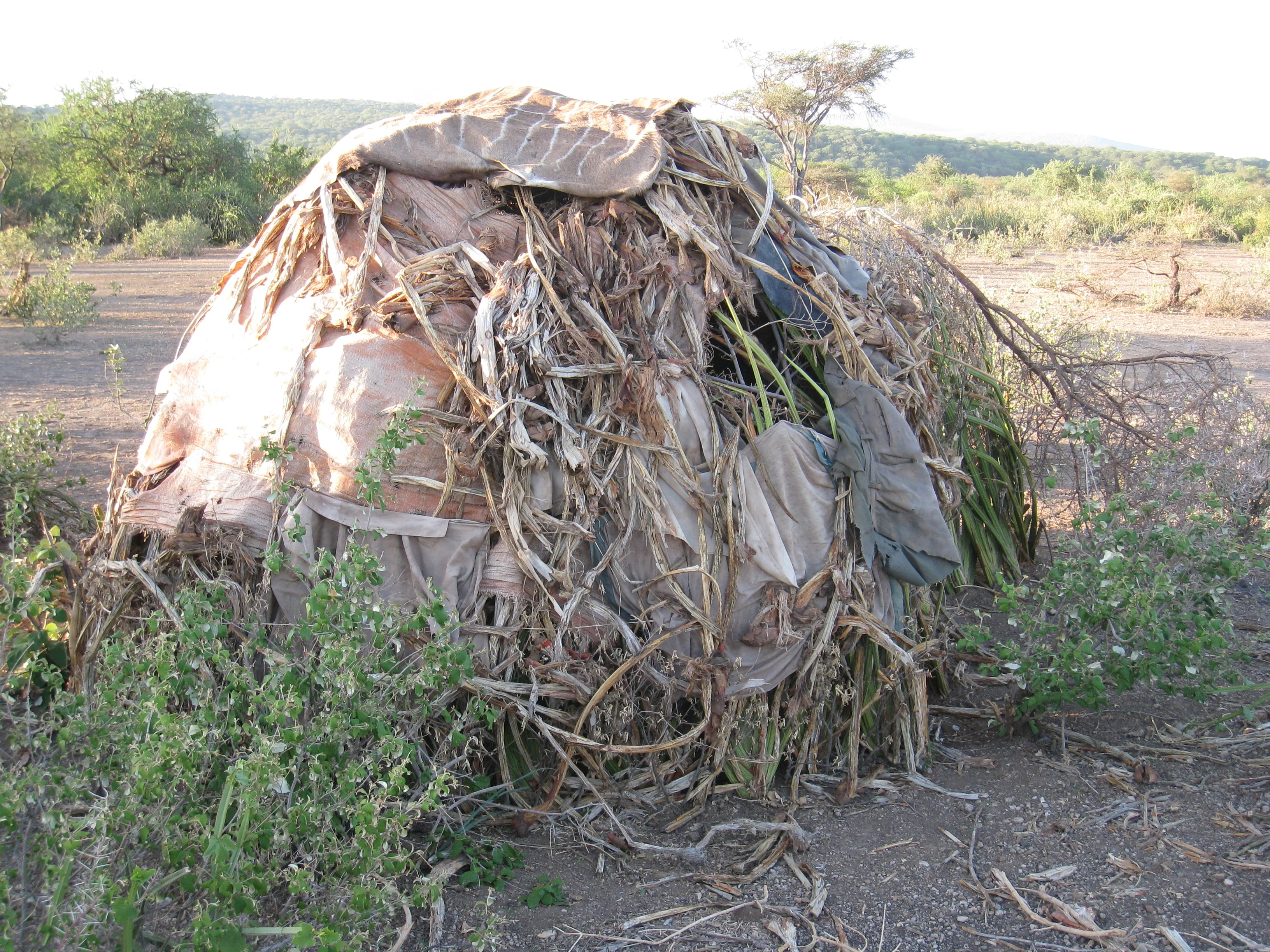
The Hadzabe live in small camps of 20 to 30 people that shift location seasonally, following the availability of food and water. Their shelters are simple domed structures of bent branches covered with dry grass — built in a matter of hours and abandoned without regret when the group moves. There is no concept of individual land ownership. The land belongs to everyone and to no one.
Their diet is almost entirely wild. Men hunt with handmade bows and arrows tipped with poison derived from the Adenium obesum plant — the same species sold in garden centres worldwide as the "desert rose." They hunt baboons, impala, zebra, warthog, and a range of smaller animals. Women and children gather tubers, berries, baobab fruit, and honey — which is found by following the greater honeyguide bird, a relationship between a human culture and a wild species that is thought to be at least 50,000 years old. The Hadzabe do not store food. What is gathered or hunted is shared and consumed that day.
Social organisation is flat and egalitarian. There are no chiefs, no headmen, and no formal hierarchy. Decisions are reached by group consensus. Men and women have distinct but overlapping roles — hunting is primarily male, gathering primarily female, but these boundaries are fluid. Children learn by observation and participation from infancy. There are no schools, no formal teaching structures, and yet Hadzabe children learn tracking, bow-making, plant identification, and fire-starting faster than any curriculum could teach.

The Hadzabe are not a frozen or unchanging people. Some Hadzabe have mobile phones. Some have visited Arusha. Some speak a little English. Contact with the outside world is real and has been for decades. What makes the Hadzabe remarkable is not isolation — it is active, deliberate choice: a community that has evaluated modernity and continues to choose the hunt. Understanding this makes the visit more honest and more profound.
A Hadzabe visit is not a game drive. There is no vehicle, no road, and no itinerary that runs on a clock. What you experience depends on what the morning brings. Here is what a visit typically includes — and what makes each element genuinely unlike anything else on the Tanzania northern circuit.

You depart before sunrise — often before 05:30 — following a small group of Hadzabe hunters into the dry acacia and baobab bush surrounding Lake Eyasi. The hunters move fast, silently, reading signs in the dust and the behaviour of birds that most visitors never notice. They carry handmade bows and arrows whose tips are coated in slow-acting Adenium poison. The hunt is real. Whether animals are found depends entirely on that morning. When the hunters whistle and freeze — pointing at a shape in the shadows — and then move with sudden fluid precision, it is a moment that visitors consistently describe as one of the most affecting of their lives. The walk covers 4 to 8 km on uneven ground in rising heat. Wear closed shoes and bring water.
At the camp, Hadzabe men demonstrate the making and use of their bows and arrows — tools made entirely from wild materials found within walking distance: the bow from specific flexible wood, the string from animal sinew, the arrow shafts from reeds, the tips from iron (often salvaged and re-worked) and coated in Adenium poison dried to a hard black resin. Visitors are invited to try shooting the bows. The combination of unfamiliar draw weight, arrow design, and technique means most adults achieve significantly less distance than a ten-year-old Hadzabe child. This is instructive in the most enjoyable possible way.
The Hadzabe make fire using a hand-drill friction method — a vertical stick spun rapidly between the palms against a horizontal board, with the friction-generated ember caught in a dried grass bundle and blown to flame. An experienced Hadzabe fire-maker achieves a flame in under 90 seconds. Visitors are invited to try. Most need several minutes of coaching to even generate a visible ember. The fire demonstration is a compact, accessible, and deeply memorable demonstration of a skill that most modern humans have entirely lost — and that the Hadzabe use daily.
While the men hunt, Hadzabe women and children gather plant foods — and visitors can accompany them. The foraging walk moves through the same dry bush, but the lens is completely different: what looks to most visitors like barren scrubland is, to a Hadzabe woman, a visible and navigable larder. She points to a specific place where soil colour signals a buried tuber. She identifies edible berries by subtle leaf shape in a thicket of apparently identical shrubs. She knows which baobab pods have ripened and which have not. The walk typically takes 1 to 2 hours and usually includes tasting — wild berries, tubers, and occasionally baobab fruit eaten straight from the pod.

For visitors who stay overnight near Lake Eyasi, a second visit to the Hadzabe camp in the evening reveals a completely different dimension of Hadzabe life. As the day cools and the fire is lit, the camp comes alive with song. Hadzabe music is polyphonic — multiple interlocking vocal parts building into complex harmonies over rhythmic clapping and percussion. Women and men sing separately and then together. The sounds carry across the dark lake. By firelight, under the Lake Eyasi night sky (one of the darkest in northern Tanzania, with no light pollution), this is an experience that is difficult to adequately describe in advance.
A Hadzabe visit is one of the most meaningful cultural experiences available in Tanzania — and one of the most easily exploited. The difference between a visit that benefits the community and one that treats them as a zoo exhibit comes down to how it is organised, who receives the money, and how you behave when you arrive. These rules are non-negotiable.

The Lake Eyasi Hadzabe visit is one of the most poorly regulated cultural tourism experiences in Tanzania. Many operators run large-group "Hadzabe shows" that have no community consent agreement and pay nothing to the Hadzabe directly. These visits are exploitative and cause measurable harm. Resilience Safaris visits only the communities we have worked with for years, pays fees that go directly to the camp leadership, and keeps all groups to six people or fewer. Ask any operator directly: who receives the community fee, and how much?
The Hadzabe can be visited year-round, but road conditions, heat, and bush density vary significantly with the season. Here is exactly when to go for each type of experience.
The Hadzabe camps are located on the western and southern shores of Lake Eyasi, approximately 150–180 km from Arusha by road. The journey takes 3.5 to 5 hours depending on your departure point and route. A 4x4 vehicle is required for the final section. There is no public transport to Lake Eyasi. All Hadzabe visits are arranged through tour operators — not accessible independently.
| From | Route | Distance | Drive time | Note |
|---|---|---|---|---|
| Arusha | Arusha → Makuyuni → Karatu → Lake Eyasi | ~180 km | 3.5–5 hrs | Standard route |
| Karatu | Karatu → Lake Eyasi direct | ~45 km | 45–75 min | Ngorongoro base |
| Ngorongoro Crater | Crater rim → Karatu → Lake Eyasi | ~60 km | 1.5–2 hrs | Morning departure |
| Serengeti (Seronera) | Naabi Gate → Ngorongoro → Karatu → Eyasi | ~250 km | 5–7 hrs | Overnight Karatu recommended |
The Hadzabe visit pairs perfectly with Ngorongoro Crater, since Karatu — the gateway town for both — is the same base. A common itinerary: Ngorongoro Crater descent in the morning, overnight in Karatu, Hadzabe dawn hunt the following morning, then north to Lake Manyara or Tarangire. This requires zero backtracking and adds only one extra night to a standard northern circuit safari. Resilience Safaris builds this combination into custom northern circuit itineraries — contact us to add a Hadzabe visit to any existing safari plan.